Navigation

     Contact Details

     Peter Miles
     Northam, Western Australia
     QRZ Page: VK6YSF


     Email


       Social Media


    Buy me a coffee

If you found information on this site interesting, beneficial, or learned something new, please consider buying me a cup of coffee by clicking the coffee cup below. It helps keep the website going and is greatly appreciated.


POLARITY OF THE COAX CONNECTION FOR J-POLE ANTENNAS

QRZ Forum discussion on the polarity of the coax connection for J-pole antennas. Not all comments have been reported from the discussion.


HOME  > PROJECT > SUPER J-POLE FOR 435MHz >

QRZ Forums

QRZ Forums > Amateur Radio Technical Forums > Antennas, Feedlines, Towers & Rotors


Original question raised by myself:

I can't see that it makes much difference, but is there any deference which way the coax is connected to a J pole antenna. Is it better to have the centre of the coax connected to the main element or the stub?
I notice that most if not all J pole designs on the net have the centre of the coax connected to the main element, however when I refer to a 1977 ARRL antenna book it has it connected the other way.

Is there any difference?


Mike W0BTU commented:

Hello Peter,

I would explain more, but it's 3:15 AM here in Missouri.

Do a search for J-pole in the qrz.com forums. You'll find that it works, but it has a feedline radiation problem.

__________________
73, Mike
www.w0btu.com


W8JI commented:

Look at patterns at the bottom of this page:
http://www.w8ji.com/end-fed_vertical...ontal_zepp.htm

See exert below:

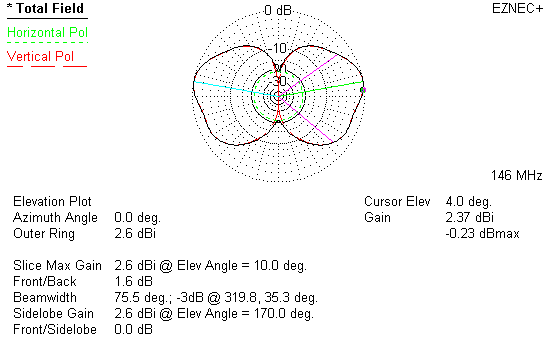
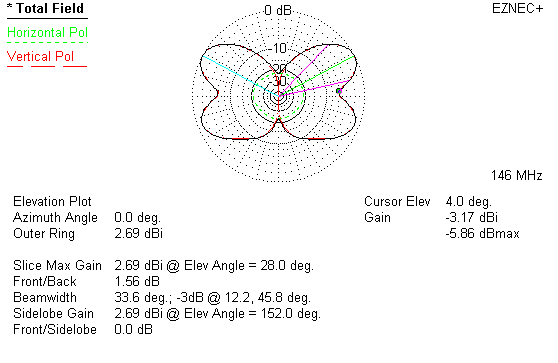
You'll see the feedline or mast grounds directly to what everyone assumes is a "zero voltage" point. This is the electrical equivalent of any J-pole with the coax connected in series with the feedpoint, and the shorter leg connected to the shield. The shield can be connected to any supporting mast with any change in results. Here is the resulting pattern:


Shorter leg to shield:
 

Longer leg to shield:


TOP OF PAGE

Page last revised 12 March 2022


   Space Weather

   https://www.swpc.noaa.gov/


   Notice Board

VK6YSF JS8Call and Olivia 8/250 operations.

Current activity is generally focused - though not restricted to - JS8Call operations on the 20m, 30m, and 40m bands.

Currently there is a particular emphasis on JS8Call on the 10 and 12 m band between 00:00 and 12:00 Z, often extending beyond this period.

Olivia 8/250 is used occasionally on the 20m band.

Proposed band and mode activity is often communicated on HamSpots: https://hamspots.net/js8/ or my profile on 

X: https://x.com/vk6ysf97230 .  

Feel free to contact me to discuss or arrange a schedule for a contact.

Post date: 7 December 2025


Western Australian SSTV net 

Popular Western Australian SSTV net for both digital and anolog SSTV.

Generally found at 7214.0kHz LSB every afternoon from 08:00 UTC (4:00pm WST)

For more details: https://www.wasstv.net/wasstv.net/index.html

Post date: 8 December 2025


VK6MJM LF (136kHz) and MF (474kHz) Beacon

VK6MJM is a  LF/MF station located in Manjimup, Western Australia.

Common Mode: FST4W 300 (Similar to WSPR)  

Note: other modes and sub-modes may be used.

Station details were presented by Peter Hall (VK6HP) at PerthTech 2024.Presentation PDF: Peter Hall VK6HP at PerthTech

QRZ Page: VK6MJM on QRZ.com

Post date: 10 March 2025


All content may be used for unlimited distribution with full credits.

Amateur Radio Station VK6YSF - Promoting amateur radio communication and experimentation.