|
LAST VOICE STANDING - OFF
GRID COMMUNICATION
Off
the grid and portable
HF radio communication for
camp
site, POTA and SOTA operations.
Published in the WANSAC (Western
& Northern Suburbs Amateur Radio Club) monthly club magazine.
Issue
February 2026
http://www.wansarc.org.au/
The
Last Voice Standing
-
Off-Grid
Radio Communication
By
Peter Miles – VK6YSF
My
current version of Off-Grid
Radio Communications
Exploring remote locations, including off-the-grid camping, has been and still is one of my greatest joys, and when a bit of radio communications is part of the adventure, well, it can’t get much better than that.
A camping trip, a Parks On The Air (POTA) activation, or being prepared for an emergency
- reliable and straightforward off-grid radio communication is the key. A modest but well-chosen
set-up that can handle voice and data modes even when no mains power or infrastructure is available is, in my mind, the minimum requirement.
From fun voice chats with fellow hams to sending digital messages or emergency check-ins, the system needs to be reliable and adaptable to band conditions, and while VHF, UHF, and repeaters have their place, here we’re talking about a standalone, long-distance HF radio communications system.
For a campsite, a park activation, or putting together an emergency communications kit, having the right gear makes all the difference.
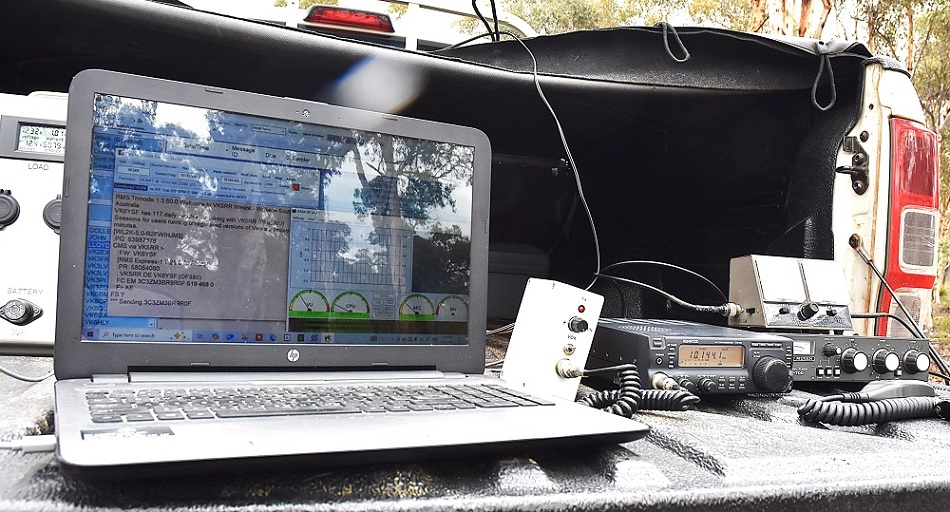
Photo 1 Back of the 4WD
set-up with the HP laptop, PC to radio Interface, Kenwood TS50 and
Yaesu FC-700 manual tuner. The laptop screen shows a successful
Winlink email connection in progress.
Possibly emailing Mark - VK3PI of what I'm up to.
Using traditional SSB (or FM) voice
remains one of the most immediate and intuitive ways to communicate.
It’s ideal for coordinating with other stations, local nets, or
emergency traffic. However, beyond voice - when band conditions are
poor and signals are weak - digital modes provide longer-range,
resilient communications with low power, often less bandwidth, and
more flexibility. Keyboard-to-keyboard digital modes offer a clear
printed message record with no ambiguities or confusion, that can
sometimes occur with voice traffic. While I will always be keen to
experiment with the vast array of available digital modes, I have a
small selection that has proven both reliable and popular, each
serving particular needs.
Winlink - Enables emails to be sent
over HF within a standard SSB voice channel. The email is sent to
one of the various Winlink gateway stations (also known as an RMS -
Radio Message Server) located around Australia and the world, and
from the gateway the message is automatically forwarded via standard
internet infrastructure to almost any email address. Email traffic
works both ways, and the recipients do not need to be licensed radio
amateurs - very useful.
Olivia 8/250 - A robust, narrowband HF
mode for challenging conditions when propagation is marginal. Olivia
is a basic point-to-point text communication mode with few extra
features; however, unlike JS8Call for example, Olivia doesn’t
require time syncing and is therefore suitable for extended off-grid
communications, where a standalone laptop’s clock can drift over
time and render some digital modes inoperable. While Olivia has many
sub-modes, my experience is that the 8/250 sub-mode is almost the
universal standard for operations on all bands these days, with the
most popular bands being 20m (14.0715 MHz) and 40m (7.0715 MHz).
JS8Call - A modern weak-signal mode
derived from FT8/FT4, that allows a conversational style texting on
HF with very low power. JS8Call is feature-rich, with an email style
message inbox, message forwarding, or simple keyboard-to-keyboard
communication. It has an exceptionally good signal-to-noise ratio
and, in my experience, is the most resilient weak-signal
keyboard-to-keyboard mode available at this time. It is also quite
popular, with strong activity in the afternoon on 20m (14.078 MHz)
and in the early evening on 40m (7.078 MHz). The trade-off for
weak-signal resilience is a relatively slow baud rate; however, when
there is good signal, JS8Call can be switched to a fast baud
rate known as Fast, or even faster baud rate known as Turbo - and
Turbo is much faster than I can comfortably type. Importantly,
JS8Call will attempt to decode irrespective of the other station’s
selected speed.
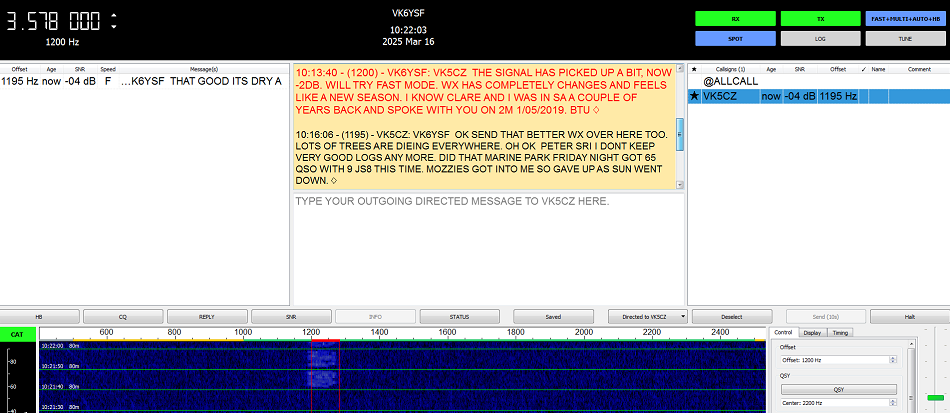
Photo 2 JS8Call screen shot. 80m band contact with VK5CZ.
All three of the above modes give you options when you’re off-grid and
want reliable communications that are less demanding on your power
budget and antenna perfection. The digital mode applications are
pre-loaded with templates for Winlink messages, as well as various
shortcut macros for JS8Call and Olivia to help facilitate efficient
communications.
The HF transceiver I'm using for portable work is a Kenwood TS 50, a
compact basic radio that, while lacking many features is suitable
for QRP or full 100W SSB transmission.
The Kenwood TS-50 transceiver is well suited for portable operation,
especially when used with the AT-50 automatic antenna tuner.
However, it lacks a VOX (voice-operated transmit) function, and
while there are various ways to activate the PTT (push-to-talk) when
operating digital modes, some modes - such as Winlink - require
either advanced radio interfacing or rely on the radio’s VOX
feature to key the transmitter. Due to limitations in both the TS-50
and certain software, a radio-to-computer interface in this set-up
must include a built-in VOX circuit. Obviously, with a radio that
has a VOX feature, the interface circuit is greatly simplified.
The radio-to-computer interface that I designed and constructed includes
a VOX feature for all digital-mode PTT triggering, along with
isolation transformers in the audio paths between the radio and
laptop to prevent noise transfer between equipment.
The interface successfully operates all digital modes such as Winlink,
JS8Call, WSPR, and Olivia, and should be compatible with most
similar modes.
Keeping the laptop or tablet in a suitable location to minimise RF
interference, using ferrite line suppression, keeping cables
separated, and installing an earth with the shortest possible cable
to the HF radio are all necessary steps in preventing RF feedback
and ensuring a clean, reliable signal.
None of this works without an antenna, and I’m currently using two
antenna configurations successfully; however, I’m always
experimenting to create the ultimate portable antenna - an elusive
pursuit for sure.
A portable linked-section ground-plane antenna for rapid campsite
deployment, with a small footprint, allows relatively quick set-up
and is suitable for use with a fibreglass squid-pole mast, without
requiring any existing supports such as trees. As it’s currently
designed, this antenna is limited to the upper HF bands from 14 MHz
to 28 MHz.
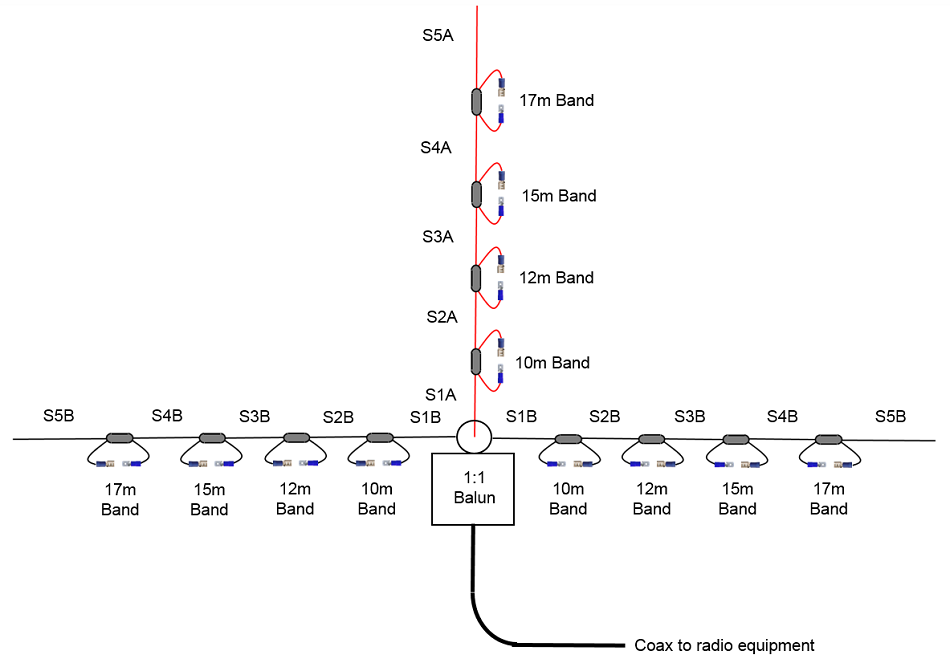
Fig
1 The multi-band ground plane antenna link arrangement.
Note that only two of the ground plane radials are shown for simplicity,
however it is
intended that there normally be 3 radials.
A multi-band dipole antenna provides
broader HF band coverage from 3.5 MHz to 30 MHz when time allows.
The multi-band dipole requires a bit more space but offers excellent
flexibility across all HF bands. It can be worth taking the time to
orient this antenna for the best take-off on the higher bands due to
the often complex multi-lobed radiation pattern on the upper HF
bands, as shown in Fig. 1.

Photo
3 The centre support
of the multi-band dipole
for broader HF band coverage from 3.5 MHz to 30 MHz. The total
length of the dipole is 30m.
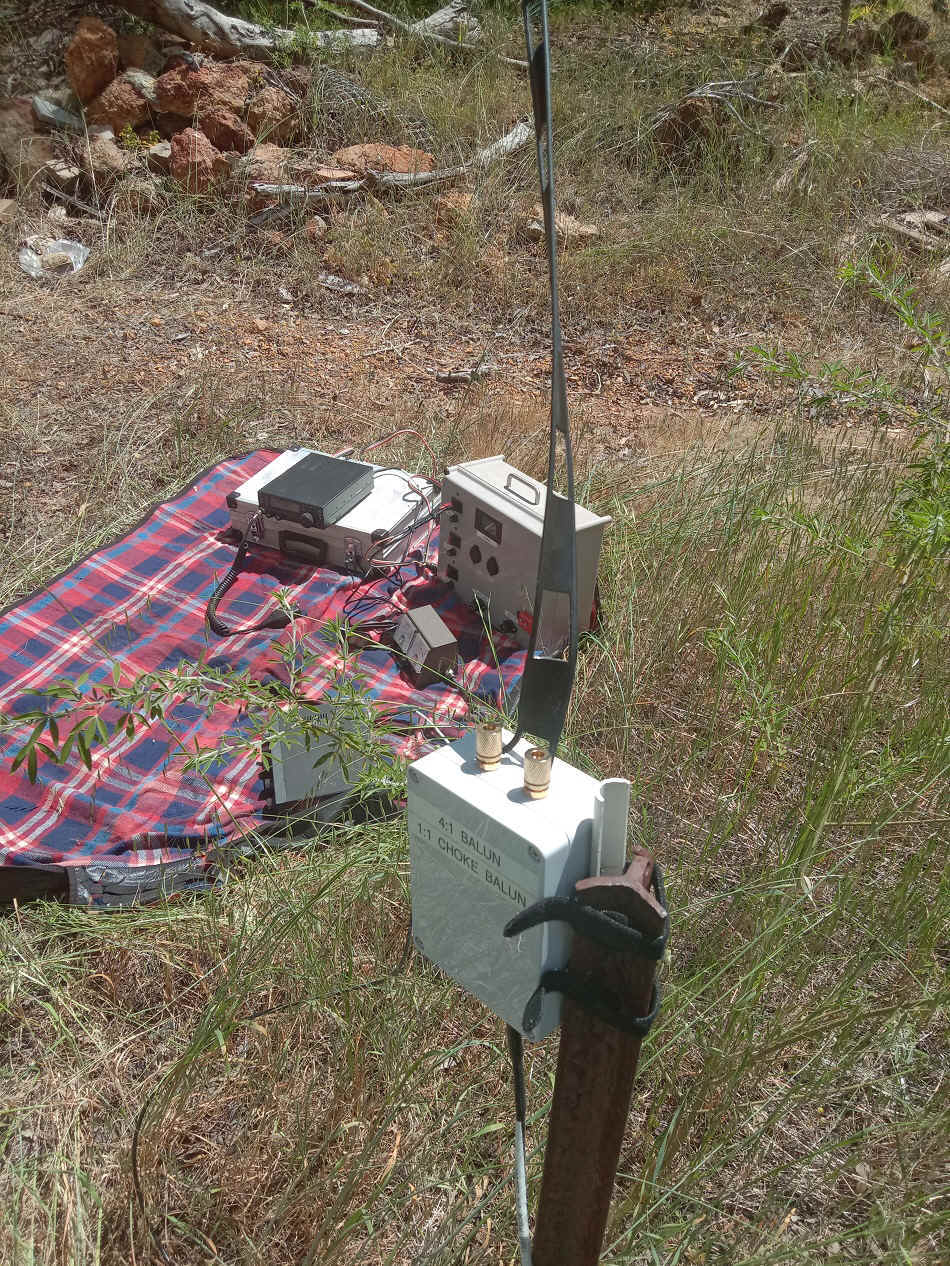
Photo
4 The
on the ground radio equipment with balun connection to the open wire transmission line in the foreground.
Worked David - VK4OF with SSB on 10m during this test run.

Fig 1 MMANA-GAL antenna
model prediction: The antenna at 10m with a very complex multi-lobed
pattern
In
remote areas, or when the grid fails, reliable 12 V battery systems,
solar charging, and efficient equipment form the fundamental basis
for a communication system - and even for survival.
For
extended periods of off-grid camping the power system needs to be
well constructed to avoid intermittent faults, possible fires and equipment
damage. The system needs a sufficiently large capacity battery and
in my case I have chosen a 97Ah lead acid battery of the same type
as that used in my four wheel drive, so that if the vehicle battery
was to fail I have a replacement to drop in.
As
important as battery storage is, you still need a reliable way to
generate power - and for off-grid set-ups, solar is king. It’s
quiet, efficient, and requires no fuel. My system uses a 160-watt
fold-out portable solar panel, which provides more than enough
capacity for extended camping trips.
Reliability
is dependent on a well design distribution board or system that has
circuit fuse or circuit-breaker protection and quality standardised
connectors, such as Anderson connectors.
I
like to know what is happening on the power system at a glace and
have included a digital power monitoring meter that displays;
battery voltage, system load and energy (Wh or kWh) consumption. The camping
trailers also includes metering for generation, so that for
long duration stays I can know that I'm generating enough power to
cover the average load for the stay.

Photo
5 Camping trailer DC distribution board and
water pump. The right side metering shows generation data, such as
current, power and most importantly energy in Wh, the left meter
presents data for the system load.
For shorter duration
radio operations a small more compact version of camping trailer’s
12V systems is used.
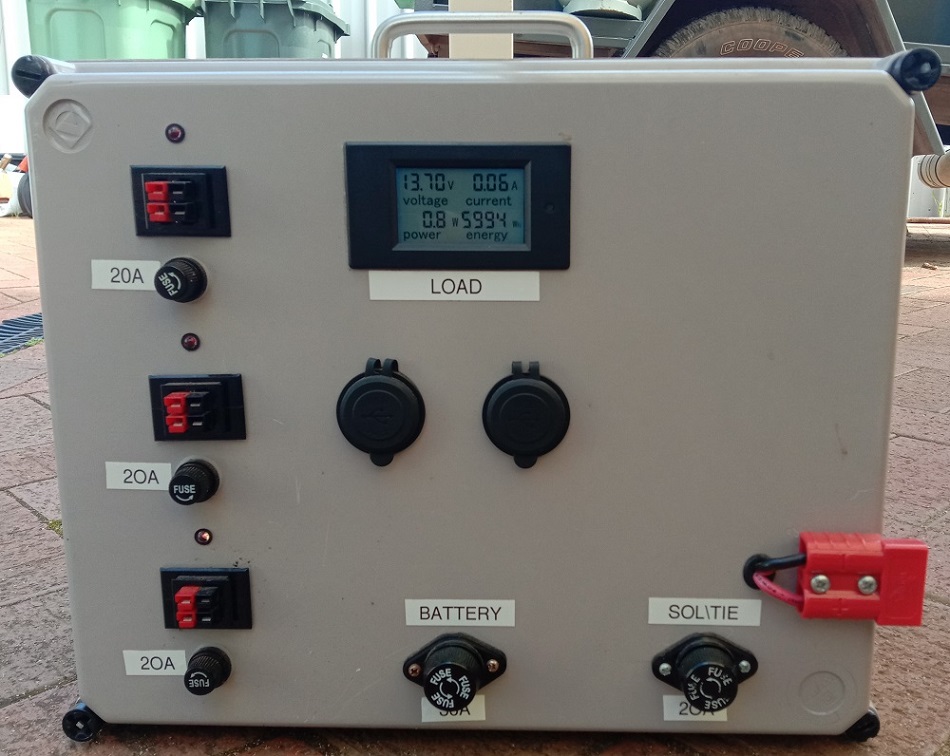
Photo
6 Compact
power box containing the battery, fuse protection, metering and
Anderson connectors. Also not clearly shown are USB outputs phone
charging etc.
Standardisation of all connectors to allow for
simplicity and flexibility in set-ups with 50A Anderson connectors
for major loads such as12/230V inverters, 30A Anderson for all other
loads including transceivers. All RF connectors are standardised
with the old reliable PL259 and SO239 connections that cheap and
well suitable for HF frequencies.
Where possible, it’s very useful to have all
required equipment in one or two go-boxes. I learned this from
bitter and embarrassing experience - that after a day’s drive to a
remote location, only to find that a critical bit of kit had been
forgotten. I’ve now got the basic kit down to two boxes, plus the
pre-packed gear in the camping trailer. To back up the trailer and
the equipment boxes, there is a fairly comprehensive checklist to
ensure there will be an operational station at the destination. Just
think Thunderbird 2.
Finally, a basic station that includes a reliable
power supply, an efficient antenna system, and the ability to handle
both voice and digital modes means you’re not locked into one
style of communication and can pivot to whichever mode best suits
propagation, power budget, or other operational requirements. For
example: a POTA activation using the multi-band dipole for full HF
coverage, Winlink to send activation data, and switching to OLIVIA
when conditions deteriorate.
Off-grid radio communication is far more than just
turning on the radio - it’s about designing and deploying a system
that is self-sufficient, flexible, and robust. With correct gear,
experiences, repair-capability and the use of both voice + digital
modes, this is a winning combination. Whether it’s a relaxed
weekend's activation or a serious emergency role, there is the tools
and mindset to deliver reliable communications and maybe be the Last
Voice Standing.
References:
Kenwood
TS-50S compact HF transceiver
https://vk6ysf.com/ts-50_20250624.htm
Mult-band
HF portable linked section ground plane antenna - 14 MHz to
28MHz https://vk6ysf.com/hf_portable_linked_section_ground_plane_antenna-20251023.htm
Portable
HF Doublet Antenna for a frequency range of 3.5MHz
- 30MHz https://vk6ysf.com/hf_multi-band_dipole-20250825.html
Kenwood
TS-50 radio - laptop interface with internal USB soundcard and VOX
circuit.
https://vk6ysf.com/radio_soundcard_interface_20250415.htm
12V distribution
for managing solar off-grid camping https://vk6ysf.com/dc_distribution_off_grid_20250219.htm
Olivia
band-planhttps://vk6ysf.com/olivia_freq.htm
JS8Call overview
and international
band-planhttps://vk6ysf.com/JS8Call_20241005.html
Article
about the reliance on modern communication infrastructure and where
amateur radio can fit in.
https://vk6ysf.com/last_voice_standing-20250709.htm
Winlink Global Radio Email
https://winlink.org/
Parks on the Air
(POTA) Parks
on the Air | POTA | Parks program for amateur radio.
TOP
OF PAGE
Page initiated 02
February, 2026
Page
last revised 02 February, 2026
|


