|
Navigation
Contact Details
Peter Miles
Northam, Western Australia

Email

Social
Media


Buy me a coffee
|
If you found information on this site interesting, beneficial, or learned something new, please consider buying me a cup of coffee by clicking the coffee cup below.
It helps keep the website going and is greatly appreciated.

|
|
|
|
LES-5
(Lincoln Experimental Satellite 5)
LES-5 Background and technical
overview.
HOME >
OPERATIONAL
> MODES
& FREQUENCIES > SATELLITES
- RADIO TARGETS >
LES-5 was part of a program investigating whether relatively small military terminals could communicate over long distances using UHF satellite communications.
Instead of requiring large, accurately pointed antennas, UHF allowed comparatively simple antennas to be used on:
aircraft, ships, land vehicles and mobile military terminals.
LES-5 carried a frequency-translating UHF-to-UHF transponder and an automatic antenna-switching system. As the spacecraft rotated, the system selected the appropriate Earth-facing antenna.
It also incorporated Lincoln Laboratory's Tactical Transmission System (TATS) and Terminal Access Control System (TACS) technologies.
The work eventually influenced operational military satellite systems including FLTSAT, UFO, and later MUOS.
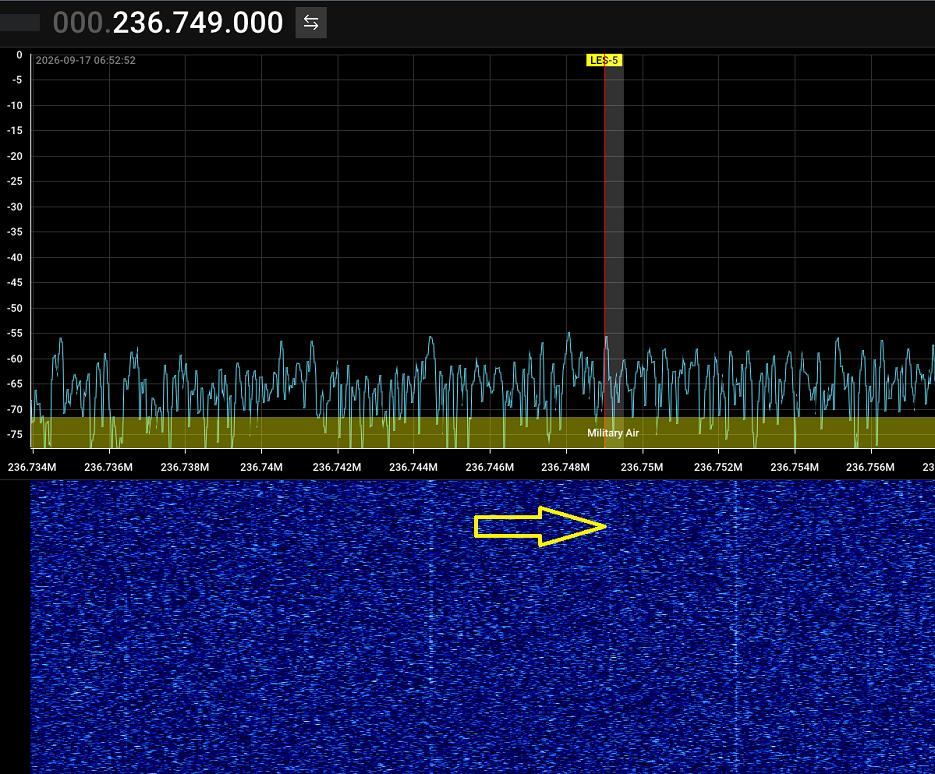
In March 2020, Canadian amateur radio operator Scott Tilley, VE7TIL, deliberately searched the old UHF satellite frequencies and discovered a signal from LES-5.
The signal was around 236.7487–236.75 MHz and was identified as the satellite's telemetry beacon.
It wasn't simply an unmodulated carrier.
The telemetry uses approximately 100-bit/s BPSK. Daniel Estévez, EA4GPZ, subsequently analysed recordings and was able to recover the digital telemetry bitstream.
That's extraordinary considering that the spacecraft was already 53 years old when the signal was rediscovered.
Details
| Satellite: |
LES-5
(Lincoln Experimental Satellite 5) |
| Norad ID: |
2866 |
| Operator: |
U.S. Air Force |
| Status: |
Out of service, however
transmitting telemetry has been detected |
| Frequency Range: |
236.750 MHz. +/- Doppler |
| Mode: |
Carrier (Very weak) |
| Altitude [km]: |
33400 +/-
Near-geosynchronous, near-equatorial (Junkyard orbit) drifting
eastward. |
| Tracking: |
https://www.n2yo.com/?s=2866&live=1 |
Reception Reports
References
TOP
OF PAGE
Page initiated 17 September, 2026
Page
last revised 17 September, 2026
|
|
|
Space Weather
https://www.swpc.noaa.gov/
|

Michael Faraday
born 22 Sep 1791
Shaping the modern electrical age, Michael Faraday (1791–1867) was a pioneering British scientist who transformed our understanding of electricity and magnetism. His discoveries included electromagnetic induction, which laid the foundation for electric generators and transformers, as well as the principles behind the electric motor.
|
Notice Board
|
VK6YSF JS8Call and
Olivia 8/250 operations.
Current activity is generally
focused - though not restricted to - JS8Call operations on the 20,
30m, and 40m bands.
Olivia 8/250 is used occasionally on the 20m band.
Proposed
band and mode activity
is often communicated on HamSpots: https://hamspots.net/js8/
or my profile on
X: https://x.com/vk6ysf97230
.
Post
date: 27 August 2026
|
|
Local
Repeaters
Repeaters Page Updated
- Expanded and refreshed information on VHF and UHF repeaters across Western Australia's Central Coast, Perth, the Avon Valley, and the Peel region. New AllStar Link information has also been added, including linked repeater details and
gateway information across the State.
Repeaters
details:
https://vk6ysf.com/local_repeaters.htm
AllStar Link notes:
https://vk6ysf.com/allstar_notes-20260703.htm
Post
date: 27 August 2026
|
|
Western Australian SSTV net
Popular
Western Australian SSTV net for both digital and anolog SSTV.
Generally
found at 7214.0kHz LSB every afternoon from 08:00 UTC (4:00pm WST)
For more
details: https://www.wasstv.net/wasstv.net/index.html
Post
date: 8 December 2025
|
|
VK6MJM LF (136kHz) and MF (474kHz) Beacon
VK6MJM is a LF/MF station
located in Manjimup, Western Australia.
Common Mode: FST4W 300 (Similar to
WSPR)
Note:
other modes and sub-modes may be used.
Station details were presented by
Peter Hall (VK6HP) at PerthTech 2024.Presentation PDF: Peter
Hall VK6HP at PerthTech
QRZ Page: VK6MJM
on QRZ.com
Post
date: 10 March 2025
|
|
|
|
|