|
FLTSATCOM-8 (USA-46)
Fltsatcom-8 (USA-46)
Background and technical
overview.
HOME >
OPERATIONAL
> MODES
& FREQUENCIES > SATELLITES
- RADIO TARGETS >
FLTSATCOM-8, also designated USA-46, was the final spacecraft launched in the U.S. Navy's Fleet Satellite Communications (FLTSATCOM) series. It was launched on 25 September 1989 and was designed to provide secure and non-secure UHF communications for military users, including naval vessels, aircraft, submarines and ground stations.
The spacecraft operates in geostationary orbit, although its orbit has become increasingly inclined over its operational lifetime. FLTSATCOM-8 is particularly interesting to satellite radio monitors because of its UHF communications payload and the relatively simple architecture of many of its transponders.
UHF communications payload
The FLTSATCOM system uses UHF transponders to provide communications over relatively narrow frequency channels. The spacecraft receives an uplink signal, translates it to the appropriate downlink frequency and retransmits it. This bent-pipe architecture means that the satellite itself does not necessarily decode the information being transmitted.
Satellite
location history.
FLTSATCOM-8 was originally part of a worldwide UHF military communications architecture. FLTSATCOM satellites supported communications for naval, Air Force and other military users, with the later FLTSATCOM spacecraft also carrying an EHF package.
The original 23°W location provided Atlantic coverage.
Moving the spacecraft eastward later in its life potentially provided a way of obtaining useful coverage from an ageing spacecraft without requiring it to remain in its original role. However, the precise operational rationale for each manoeuvre is not publicly documented and not possible to assign a specific military purpose to the 2019 relocation.
There is also a broader strategic pattern: the U.S. military has progressively transitioned from the older FLTSATCOM generation toward newer UHF satellite systems. The 2026 U.S. Space Force Almanac identifies FLTSATCOM-8 as one of the two remaining active FLTSATCOM satellites.
FLTSATCOM-8's present position at ~126°E is not simply the result of 37 years of uncontrolled orbital drift. Its history shows multiple deliberate orbital changes, including changes to inclination and a major relocation followed by eastward drifting.
Details
| Satellite: |
FLTSATCOM-8 (USA-46) |
| Norad ID: |
20253 |
| Operator: |
US Navy |
| Status: |
Operational,
however superseded by MUOS. |
| Frequency Range: |
240.0 -
270.0 MHz VHF Down Link
|
| Mode: |
FM |
| Altitude [km]: |
35,800km
Geosynchronous, near-equatorial at
Longitude 126.41 |
| Tracking: |
https://www.n2yo.com/?s=20253&live=1 |
FLTSATCOM-8 (USA-46), the most useful published channel information is the Charlie-band allocation associated with the Atlantic FLTSATCOM-8 position. There are both narrowband ~4.5–5 kHz channels and 25 kHz channels. The historical monitoring data specifically identifies the narrow FLTSATCOM-8 signals as about 4.5 kHz wide, with 500 Hz spacing.
Channel
confirmation was achieved by monitoring the channel frequency for
consistency with the band plan, verifying the bandwidth and antenna
targeting to assess the SNR (signal-to-noise ratio).
|
|
Bandwidth |
Status |
| 244.145 |
~4.5–5
kHz |
Narrowband
- Nothing conclusive heard. |
| 244.155 |
~4.5–5
kHz |
Narrowband
- Nothing conclusive heard. |
| 244.165 |
~4.5–5
kHz |
Narrowband
- Nothing conclusive heard. |
| 244.170 |
~4.5–5
kHz |
Narrowband
- Nothing conclusive heard. |
| 244.175 |
~4.5–5
kHz |
Narrowband
- Nothing conclusive heard. |
| 244.180 |
~4.5–5
kHz |
Narrowband
- Nothing conclusive heard. |
| 244.185 |
~4.5
kHz |
Narrowband
- Nothing conclusive heard. |
| 244.190 |
~4.5
kHz |
Narrowband
- Nothing conclusive heard. |
| 244.195 |
~4.5
kHz |
Narrowband
- Nothing conclusive heard. |
| 244.160 |
~4.5–5
kHz |
Narrowband
- Nothing conclusive heard. |
| 244.200 |
~4.5
kHz |
Narrowband
- Nothing conclusive heard. |
| 244.210 |
~4.5
kHz |
Narrowband
- Nothing conclusive heard. |
| 250.650 |
25
kHz |
Fleet
broadcast - Confirmed 2026 (Weaker than
other transponders) |
| 252.150 |
25
kHz |
Wideband
/ relay - Confirmed 2026 |
| 253.850 |
25
kHz |
Navy
relay - Confirmed 2026 (Data) |
| 255.550 |
25
kHz |
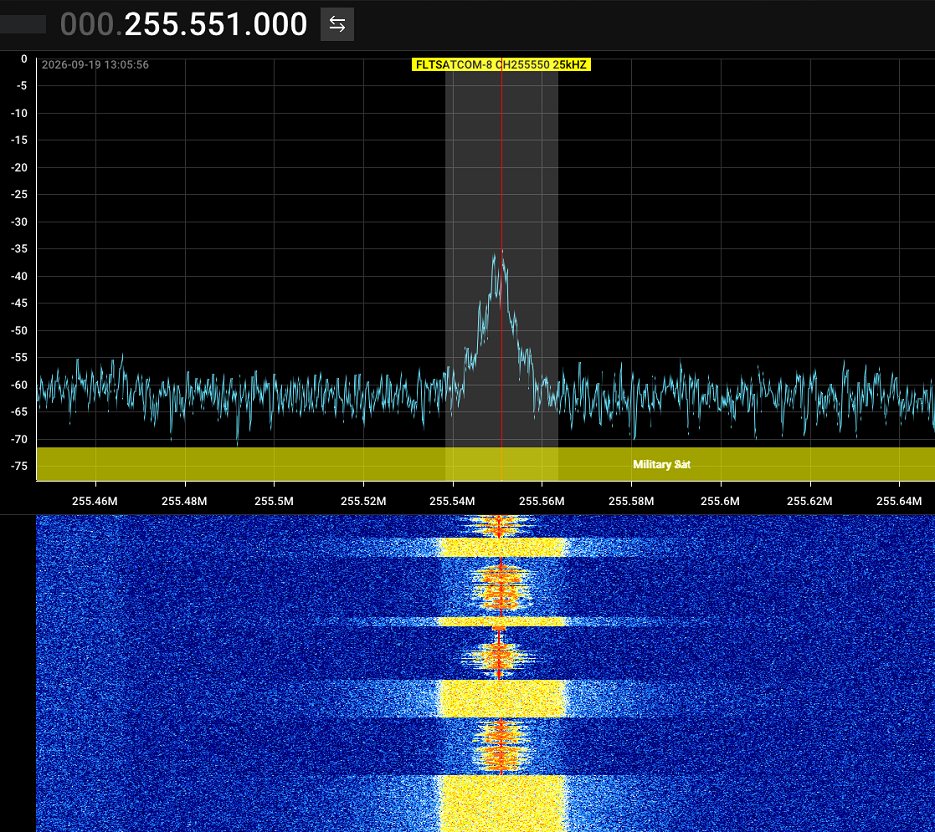
Navy
relay - Confirmed 2026 (Russian pirate station) |
| 257.150 |
25
kHz |
Navy
relay - Confirmed 2026 |
| 258.650 |
25
kHz |
Navy
relay - Confirmed 2026 (Weaker than
other transponders) |
| 265.550 |
25
kHz |
Navy
relay - No transponder heard |
| 267.050 |
25
kHz |
Navy
relay - No transponder heard |
| 268.450 |
25
kHz |
Navy
relay - No transponder heard |
| 269.950 |
|
|
Reception Reports
|
|
| Screenshot 1 A
Russian pirate station testing the channel. 27dB above
the noise floor |
References
TOP
OF PAGE
Page initiated 19 September, 2026
Page
last revised 19 September, 2026
|